
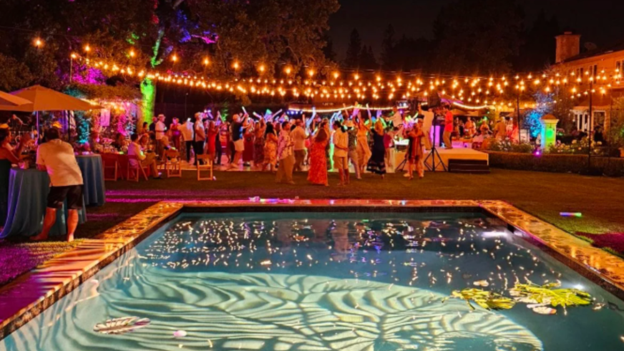
The Right Lighting Can Completely Transform the Feel of Your Wedding Venue.
You walk into your venue for the final walkthrough, and it’s just… a room. Beige walls, fluorescent overheads, chairs stacked in the corner. But when you picture your reception, you envision golden light on the walls, your monogram shining on the dance floor, and a room that feels like it was built just for this night!
Sometimes the gap between “empty room” and “reception you’ll remember” comes down to lighting. If you’re searching for Bay Area wedding AV services and keep seeing terms like uplighting, gobos, and pinspots without a clear sense of what they actually do, this breaks it down.
Key Takeaways
- Wedding reception lighting combines uplighting, pinspots, gobos, string lighting, and dance floor effects.
- Each tool solves a different problem: setting a mood, drawing attention to a feature, adding texture, or getting people on the dance floor.
- Lighting can match your wedding colors using HEX or RGB codes, and most fixtures today are wireless and battery-powered.
- A 10×10 LED dance floor handles up to 60 guests, while a 24×24 floor handles up to 400.
- You don’t need every type of lighting. Most couples pick 2 or 3 based on their venue and budget.
- Setup typically happens 2 to 4 hours before guests arrive, so your venue needs to allow for that window.
How Lighting Transforms Your Reception Experience
A lot of couples put their full budget toward flowers, catering, and the dress, then treat lighting as an afterthought. The problem: many venues weren’t designed with weddings in mind. Hotel ballrooms and event spaces often have flat, even, slightly cold lighting that photographs poorly and feels more “conference room” than “celebration.”
Lighting changes that without changing the room itself. It’s also one of the few elements of your reception that’s visible in nearly every photo, since it sets the color and mood of the background in every shot.
If your venue allows it, lighting also lets you carry your color palette through the whole space, not just the table settings. Uplighting and gobos can be programmed to your wedding’s HEX or RGB colors, so the walls match your bridesmaids’ dresses or your invitation suite.
The Main Types of Reception Lighting, Explained
Uplighting
Uplighting is usually the first thing couples add because it has the biggest visual impact for the space it covers. Wireless, battery-powered LED fixtures get placed around the perimeter of the room, pointed up at walls, columns, or drapery.
Small rooms typically need 10 to 15 fixtures. Large ballrooms can need 30 or more. The color can stay static all night (deep blue, warm amber, blush), can “dance” and move with the music, or shift slowly through a sequence.
Real-world example
A couple getting married in a hotel ballroom with beige walls chooses uplighting in a warm amber to match their fall color palette. The same walls that looked flat and corporate during the day photograph like a different room at night.
Pinspot Lighting
Pinspot lighting is a narrow beam aimed at one specific thing: your centerpieces, the cake, the bar, or the head table. It’s subtle compared to uplighting, but it tells guests’ eyes where to look.
This works well for tables with floral arrangements you spent real money on. Without a pinspot, that centerpiece sits in the same flat light as everything else and doesn’t stand out in photos or in person.
Gobo Lighting
A gobo is a small stencil or pattern placed in front of a light source. The light projects through it, casting a shape, texture, or image onto a wall, floor, or ceiling.
Common gobo patterns include vines, tree branches, foliage, clouds, and stars, plus fully custom options like your monogram or wedding date. If you’ve seen photos of a couple’s initials projected onto the dance floor during their first dance, that’s a gobo.
Real-world example
A couple wants their reception to feel like an outdoor garden, even though they’re inside. A leaf-and-vine gobo projected across one wall, combined with warm uplighting, gets most of the way there without any real plants.
String Lighting
Bistro-style string lighting, sometimes called café lighting, runs overhead or along walls. It’s less of a statement than uplighting or gobos, but it adds warmth to spaces that otherwise feel sparse, especially tented or outdoor venues with high or open ceilings.
Dance Floor Lighting
Once dinner wraps up and the dance floor opens, lighting plays a different role: it signals “this is happening now” and helps create energy. Options range from moving lights and strobes to lasers, black lights, and LED dance floors.
An LED dance floor is made of 2×2 foot tiles, each individually programmable. A 10×10 floor fits up to 60 guests; a 24×24 floor handles up to 400, with around 120 dancing at once. These floors can sync with your other lighting and shift colors with the music.
Common Misconceptions About Wedding Lighting
“We’ll just use the venue’s lighting”
Most venues have functional lighting, not mood lighting. If you’re spending an arm and a leg on photography, having mood lighting will make or break your wedding photos, even with the best photographer on-site.
“Lighting is only for big, fancy weddings”
Even a small uplighting package, 10 to 15 fixtures in your wedding colors, makes a noticeable difference in a modest-sized room.
“We can add lighting last-minute”
Lighting setup happens during the same 2 to 4 hour window as your sound and DJ setup. Adding it as an afterthought can mean less time for your AV team to do it right.
“Gobos are only for monograms”
Monograms are popular, but gobo patterns like vines, stars, and clouds can transform a room without putting your initials on every surface.
Could Your Wedding Venue Benefit from Pro Lighting Design?
You’re a good candidate for reception lighting if:
- Your venue has plain, neutral walls that don’t match your wedding colors
- You’re getting married in a space that’s also used for corporate events or conferences during the week
- You want your photos to have a consistent color story, not just whatever the room’s overhead lights happen to produce
- You’re planning a tented or outdoor reception with limited built-in lighting
- You want a moment, like a first dance or cake cutting, to feel distinct from the rest of the evening
If none of that sounds like your situation, your venue’s existing lighting might be enough. A quick conversation with your AV provider during a site visit can settle it either way.
How Techtonic Approaches Wedding Lighting
Techtonic Events has been providing AV for weddings since 2014, working with couples across Sonoma, Napa, Marin and the greater Bay Area. We have won a series of awards for our wedding services, including the Bohemian’s Best of the North Bay for six years in a row. Our team offers free consultations, including site visits, so you’re not guessing about what a space needs.
A few things that make our process easier:
- Our DJ’s are well versed in setting up basic lighting, so if you’re just looking to add a few lighting features, we won’t charge for a separate lighting technician
- Our Wedding DJ Package includes basic dancefloor lighting, so when you book one of our DJs you know your dancefloor will be exciting, engaging and enticing for your guests
- We offer lighting services in addition to DJ, audio, video and scenic services, so when you book Techtonic Events for your wedding you don’t have to worry about coordinating with multiple vendors and project managers for your technical needs
- We have over a decade of experience working with the best wedding planners in Wine Country, so we can work directly with your planner to make your dream wedding a reality, minimizing stress for the couple
- We offer free consultations, site visits and project management for all weddings under $20,000, so you’re only paying for the equipment, services and labor you see on your wedding day
Because lighting, sound, and DJ services come from one team, everything gets coordinated together instead of pieced together from separate vendors.
Light Up Your Wedding Day with Techtonic Events
If you’re not sure what your venue needs or want to see how lighting could change your space, reach out for a free consultation. Techtonic offers phone, video, in-person, and on-site visits. We also have a Lighting Slide Show available for viewing, so that you can visualize all the lighting fixtures we offer!
For the best availability, couples are encouraged to book 6 months or more in advance.
Reach out to Techtonic Events today to schedule a free consultation.
📞 (844) 483-2428
Follow Us on Instagram and see our work in action!
Frequently Asked Questions About Wedding Lighting
What is uplighting and how many fixtures do I need?
Uplighting is LED fixtures placed at floor level, pointing up at walls or features. Small rooms typically need 10 to 15 fixtures, while large ballrooms need 30 or more.
What’s the difference between uplighting and pinspot lighting?
Uplighting washes color across large surfaces like walls and pillars, setting the overall mood of the room. Pinspot lighting is a narrow beam aimed at one specific object, like a centerpiece, to draw attention to it.
Can lighting match our wedding colors exactly?
Yes. Uplighting and other fixtures can be programmed using HEX or RGB color codes, so the lighting matches your exact palette rather than a generic color option.
Do we need an LED dance floor for a small wedding?
Not necessarily. The smallest LED dance floor size, 10×10 feet, fits up to 60 guests. For smaller groups, dance floor lighting effects without a full LED floor may be enough.
How far in advance should we book lighting for our wedding?
Booking 6 months or more in advance is recommended for weddings, since lighting is part of the larger AV package and final quotes depend on confirmed venue details.
Can lighting work for an outdoor or tented wedding?
Yes. Wireless, battery-powered uplighting and string lighting both work well for tented or outdoor receptions, and equipment can be protected under tents since most AV gear isn’t waterproof.
Do we need to know exactly what we want before our consultation?
No. AV quoting for weddings is a collaborative process, and most couples go through a few rounds of conversation as their vision comes together.
Owner
Leo James is the Founder and Owner of Techtonic Events, a full-service live and virtual event production company based in Sonoma County, California. With more than two decades of experience in audiovisual design, staging, and production management, Leo has built Techtonic Events into a recognized leader in experiential events, brand activations, and corporate productions.
His expertise spans high-end conferences, festivals, nonprofit galas, and hybrid digital events, where he blends creativity, technology, and storytelling to deliver memorable experiences. Known for his calm professionalism and technical mastery, Leo leads a talented team that brings complex productions to life — from lighting and sound design to full-scale show execution.
Leo’s vision for Techtonic is rooted in collaboration, innovation, and exceeding client expectations through seamless production and genuine partnership.